“I have often stated that a theatre’s artistic programming needs a strong thematic focus.  In 2011, the Finnish National Theatre’s new premières concentrated on Finland and what it means to be Finnish.  In spring 2012 our focus is passion.  At their best, our passions give us direction and drive us towards our achievements.  At their worst, they cloud our vision.  Within passion lies that seed of human contradictions, conflict, which itself is at the very heart of drama.  The National Theatre’s forthcoming productions examine human passions in relation to work, society, sport and relationships.”
Mika Myllyaho, Director of the National Theatre, 2012

Current season

Championship skiing is the subject of the Main Stage’s new première A Nation on Skis 2012, which opens in February. Created by Mika Myllyaho in collaboration with journalists Taina West and Paula Korva, the play explores the theme of competition, with its inherent challenges and sacrifices, as a metaphor for the demands that society places on the individual.  Also in February, a new play by Paavo Westerberg entitled They Don’t Live Here Any More will open on the Small Stage.  By examining the responses of two couples in the face of tragedy, Westerberg addresses themes of insecurity and guilt in a world overshadowed by a pervading sense of threat.  In March, another new Finnish play, Paula Salminen’s  13 Sunken Years, will première in the Omapohja Studio.  The play traces the lives of three women of different generations, tied by blood as well as by the mystery of the river that runs through the town.  Peter Franzén’s best-selling autobiographical novel Over Dark Waters has been adapted for the Small Stage and will open in April.  Franzen’s impressionistic portrayal of childhood perceptions and family breakdown is brought to life in a cinematic staging by director Janne Reinikainen.

This season, a special emphasis will be placed on theatre for children and young audiences. The Willensauna Stage will host three productions for the very young.  In March, Eduard Uspenski’s classic tale of the adventures of Uncle Fedya, His Dog and His Cat will open in a new version by Jukka Rantanen, adapted specifically for pre-school ages.  Also for the very young, there will be six guest performances of Poiju Puppet Theatre’s popular production Circus Son, running from the end of January to mid-February.  Opening in April, Olga Horila’s new play Who’s Your Friend? is an interactive piece designed for primary school children about the obligations and boundaries of being a friend.  Horila’s play will also tour to children’s homes as part of the Touring Stage’s programme.  In addition, Pirjo Virtanen’s Theatre in Education unit includes many performance-related packages and events for teachers and schools, and members of the unit’s youth drama group will create their own show entitled Spectacular Heroes – tales of ordinary cheese heroes to be performed on the Small Stage.

The Touring Stage will continue to tour some of its earlier creations, such as the ecologically-themed Wasted Planet and the most recent part of its project involving refugee reception centres, Paper Bridge.  This spring a performance of nostalgic songs, My Journey Takes Many Turns, will tour in homes for the elderly, and in development is a new piece, entitled Soviet Union.  This is based on interviews with elderly Finns who remember living under the influence of Finland’s powerful neighbour.  Aside from new projects by the Touring Stage, The Club Scene is also a hotbed of activity, with monologues, music, song, talks, discussions and more taking place several nights a week in the theatre’s bar-restaurant.

The National Theatre has also invited a number of guest performances from home and abroad.  These include, for example, Slapstick Sonata, a joint production by Finland’s Circo Aereo and the Czech company Cirk la Putyka, and While Waiting by the Palestinian Freedom Theatre.  Slapstick Sonata is a visually exciting example of modern circus which brings together Mozart’s music and the comedy of silent movies.  While Waiting is based on Beckett’s Waiting for Godot and has been created by the only professional theatre currently operating in the north of the West Bank.  These performances can be seen in Helsinki in May 2012.  Other international co-operation also continues.  Minna Leino’s production Going the Distance, adapted from Miika Nousiainen’s novel about personal loss and the waning of Finnish sport, has been invited to the Almada festival in Lisbon, Portugal.

Going the Distance and many other performances from the previous season remain in repertoire, offering audiences a wide variety of style and subject.  From Pirkko Saisio and Jussi Tuurna’s anarchistic new musical farce about the current conservative backlash HOMO! to Beckett’s minimalistic modern classic and timeless portrait of human bewilderment, Waiting for Godot, and many other shows in between, there is plenty to choose from.

Historical Roots of the FNT

The Finnish National Theatre, founded in 1872, is the oldest Finnish-language professional theatre in the country. The birth of the Finnish National Theatre was closely linked to the political ideology of the late nineteenth century. Finland was part of the Russian Empire, and its intellectual elite was Swedish speaking. Finnish language and art, including theatre, became the cornerstones of a cultural movement which began in the 1860’s, gradually developed political ambitions by the turn of the century, and eventually led to national independence in 1917.

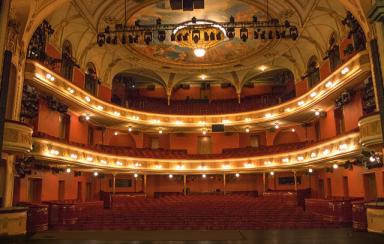
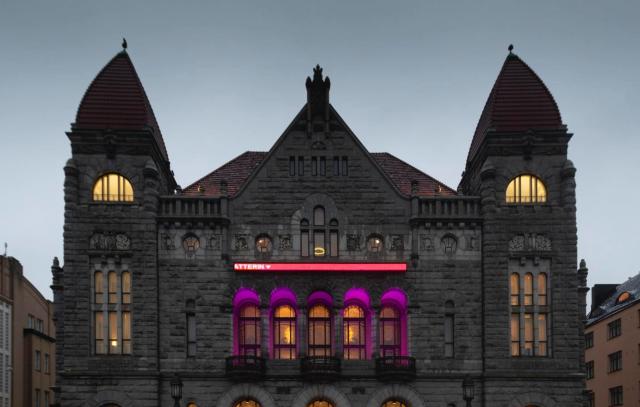
For the first thirty years of its existence, the theatre functioned primarily as a touring company. The theatre did not acquire a permanent home until 1902, when a purpose-built theatre was erected in the heart of Helsinki, adjacent to the city’s main railway station. The building design was by architect Onni Törnqvist-Tarjanne. This majestic neo-romantic edifice with its façade of Finnish granite and interiors of soapstone, marble and wood, is one of Finland’s most impressive national monuments. The theatre still operates in these premises today, and over the years the building has expanded from its original size to encompass another three permanent stages. In addition to the Main Stage (Suuri näyttämö), the theatre comprises the Small Stage (Pieni näyttämö) built in 1954, the Willensauna Stage built in 1976, and the Omapohja studio built in 1987.

In 2010 the FNT’s governing board appointed the current director Mika Myllyaho, who has expanded the theatre’s activities. He has adopted a policy of associate writers to whom the theatre is committed on a long term basis. Juha Jokela, Heini Junkkaala, Sofi Oksanen, Laura Ruohonen and Paavo Westerberg will all be writing specifically commissioned work for the Finnish National Theatre over the next few years.

The theatre also established a new production unit in 2010, which was given the name of Touring Stage. This unit, which has no fixed stage, aims to take small-scale touring performances to locations throughout the country which have little or no access to theatre, such as schools, day care centres, homes for the elderly, hospitals, welfare reception centres, prisons and so on. The Touring Stage’s programme focuses on topical issues which are developed through community research and interaction, reaching out and  giving voice to marginalised sectors of society.

In January 2011 the theatre’s former restaurant reopened as the Club Scene, transformed into a late-evening club-like entertainment spot. The space has been given a new look, refurbished in a piano-bar stroke artist’s living-room style, and hosts various types of music, drama and poetry performances as well as discussion evenings and artist soirées.

Throughout its history the Finnish National Theatre has also maintained international links in various forms of partnership with foreign theatres and festivals. This continues today as the theatre co-operates with, among others, the Helsinki Festival to bring over cutting-edge examples of world drama. Most recently, the renowned director Christoph Schlingensief’s  masterwork Via Intolleranza II was seen on the Main Stage in August 2011. The theatre also participates in text-based cultural exchanges and workshops, and regularly invites guest directors from abroad, to bring new perspectives to Finnish theatre.

Contact

General contacts
Address
Finnish National Theatre
Läntinen Teatterikuja 1
00100 Helsinki
Finland
Telephone +35810 733 11
+35810 733 1283

email addresses  are:
firstname.surname(at)kansallisteatteri.fi

Director of the Finnish National Theatre
Mika Myllyaho
Telephone +35810 733 1201

Director’s Secretary / Club Scene Producer
Hanna Reetta Majanen
Telephone +35810 733 1259 / +358 50 374 4181

Technical Director
Antti Aho
Telephone +35810 733 1264 / +358 50 320 9601

Administrative Director
Päivi Isosaari
Telephone + 35810 733 1203 / + 358 50 381 6436

Dramaturg
Michael Baran
Telephone +35810 733 1261

Dramaturg / International relations
Eva Buchwald
Telephone +35810 733 1314 / +358 50 315 2947

Dramaturg
Minna Leino
+35810 7331 321

Marketing Manager
Auli Turtiainen
Telephone + 35810 733 1220 / +358 50 375 3501

Head of Press
Mia Hyvärinen
Telephone +35810 733 1238 / +358 50 540 5062

Theatre educator
Pirjo Virtanen
Telephone +35810 733 1256 / +358 50 374 2296

Manager of Theatre Restaurant
Marjominna Artman
Telephone +35810 733 1283


Ylös ↑