
The Mirror Maze of Oppression
Then I went back into the house and wrote, It is midnight. The rain is beating on the windows.
It was not midnight. It was not raining.
- Beckett, Molloy
This essay contains spoilers. If you would like to watch the performance without any prior knowledge, please read it only after seeing the show.
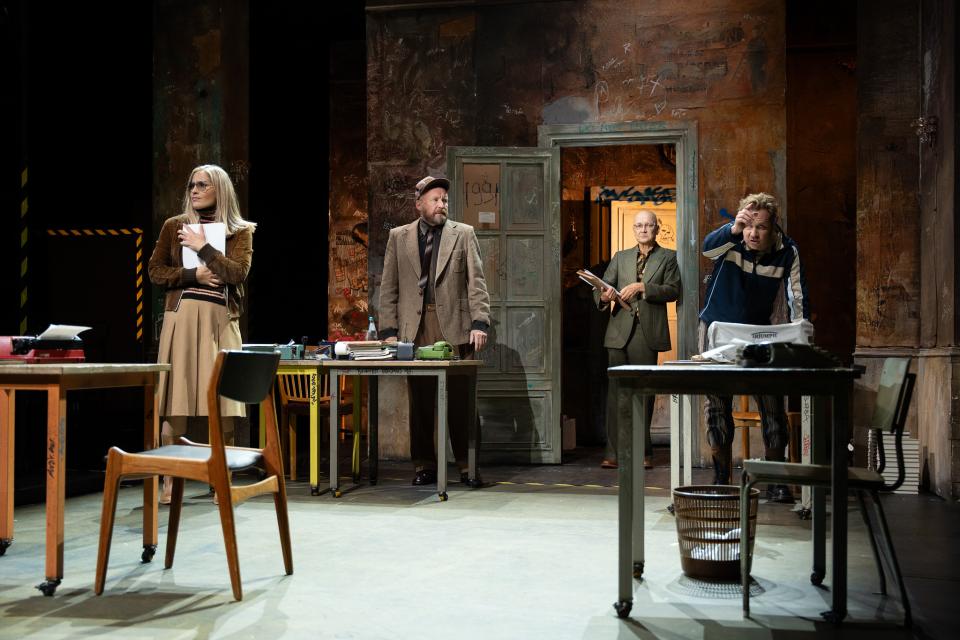
This performance of Lopetus is a contemporary stage adaptation of Imre Kertész’s novel of the same title. It was published in 2003, simultaneously in Hungarian by the prestigious Magvető publishing house and in German translation by Suhrkamp. Yet, the novel’s first iteration was an unfinished drama that Kertész began writing in 1990.
In that ‘comedy’ (Felszámolás, komédia három felvonásban / Liquidation, a comedy in three acts), Kertész was planning to depict the state of affairs after the collapse of the communist regime in Hungary in the late eighties – probably not without irony. That play, however, was never finished, but fragments of it were woven into the novel that he completed thirteen years later. In fact, in the novel, excerpts from its precursor serve as part of the unpublished manuscripts that B., the protagonist (Kertész’s alter-ego), leaves behind; and from which texts one of the narrators (Kingbitter) is trying to recall the events around his writer friend’s suicide.
Through reading various accounts by different voices: the testimonies of B’s editor, Kingbitter, the monologue of B’s former wife, Judit, the farewell letters of B. to the important women in his life, as well as several fragments and various drafts from B’s unpublished play and its accompanying notes – the chronicle of B. and of a lost, ‘fateless’, drifting generation living under oppression unfold.
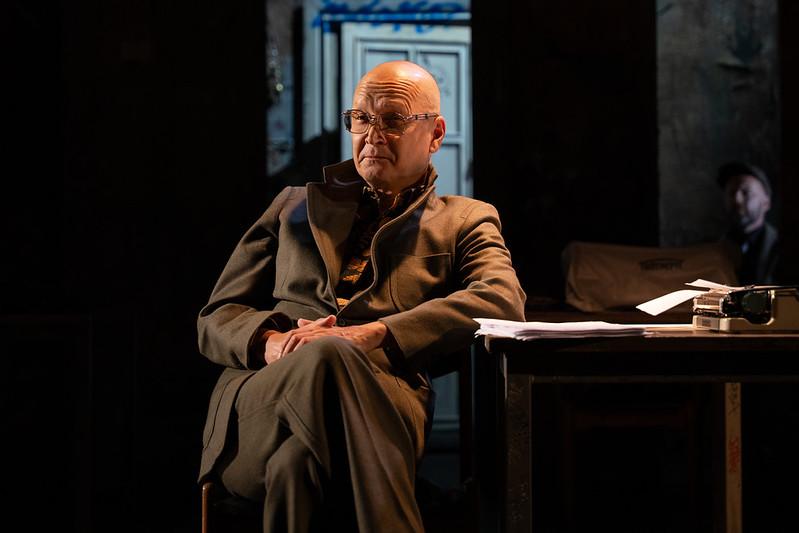
As with any story told from different perspectives, this account is unstable, its ‘reality’ is unreliable. The narrators mislead us, the protagonist is not who we would think it is, opinions differ, people are economical with the truth, concealing it or even lying about it. What is certain only is an ironic acknowledgement of an unavoidable, ongoing decline, an unheroic apocalypse we are all part of.
The Beckett quote in this essay comes from the motto of Liquidation. From the start of his novel, Kertész warns the reader about a major predicament: the impossibility of access to reality, and the complex relationship between truth and art. Kertész, noted his biographer, Clara Royer, believed that truth can only be made accessible to us through art. In fact, his credo was to live and write the same novel.
This is exactly what is at stake for Kingbitter in Liquidation: he needs to find B’s lost novel, his chef-d’oeuvre, a distilled form of reality, so that in it he could find an answer to his puzzle of whether his life can go on. Or the way he puts this question: “Am I or am I not?”
To further complicate the relationship between reality and fiction, the lost novel that the fictional character, Kingbitter, is so certain that exists is no other than another real novel of Imre Kertész: Kaddis a meg nem született gyermekért / Kaddish for an Unborn Child (1989). In that novel, the protagonist is the writer B., who explains to his wife why Auschwitz is the reason he resolutely says no to having a child. Here, the Möbius strip of Kertész’s novel connects around the subject of his every work: Auschwitz.
“Even if I seem to talk about something completely different, I am talking about Auschwitz”, wrote Kertész in his fictional journal, Gályanapló/Galley Boat-Log. Clara Royer, based on her interviews with the author, notes that the essential elements of Kertész’s work are the topic of Auschwitz; the shattered human existence distorted by totalitarian dictatorship; and the examination of the experience of European existence: depersonalisation. These themes are emphatically present in Liquidation.
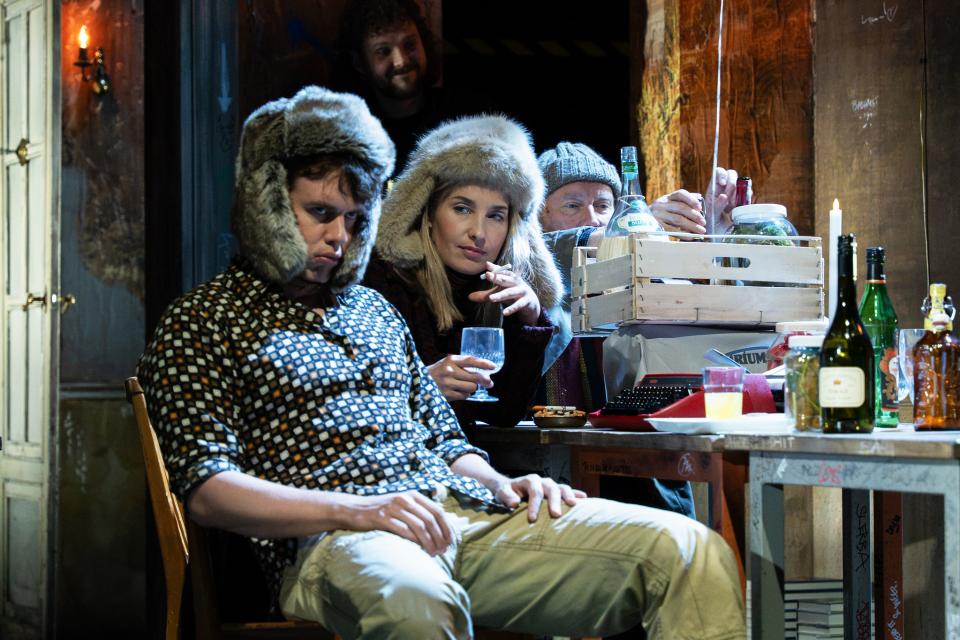
The “enigma, called Auschwitz”, the “trauma of European civilisation”, and of his own existence is that B. is trying to understand through his lifetime experimentation, whereby the observer and the observed are the same person: himself. Kertész did not accept emotional reasoning for the explanation of the Holocaust; instead, he examined it meticulously, in depth, with an almost scientific exactness, in a language that is unswayed by emotions, to find out what it is in the human nature that can lead to participating in the annihilation of others. His finding is dizzying: the positions of the executor and the victim are interchangeable. In our “age of disaster”, explains B. in the novel to Kingbitter, nobody is immune to the force, the pressure of the “horrific social milieu – the state, dictatorship, call it what you will” , that aims to collapse the centre of the Self and replace it with chaos. “[E]ach of us is a carrier of the disaster, so there is a need for a particular art of living for us to survive”- concludes B. In this world, therefore, where human actions logically lead to evil, it is the act of goodness that is the inexplicable, the illogical deed.
To take this idea on a larger, historical scale: the periods of peace, freedom, democracy and prosperity don’t last long. In the novel, instances of freedom, such as the 1989 collapse of communist rule, are only briefly mentioned, almost as a fleeting anomaly, before the state’s grip strengthens again and oppressive social formations replace the respite of independence.
In Eastern Europe, this is particularly true, where – as Kertész had experienced – a totalitarian regime was built on the nazi ruins of World War II, a dictatorship under a new ideology. A society – explains Kertész – where nobody believed in the system but everybody assimilated to it. In this absurd world where freedom was heavily restricted, to defy oppression, escape, and achieve at least some degree of individual freedom paradoxically meant a self-imposed exile within the regime’s boundaries (for those who did not leave the country), a removal from active, willing engagement and participation in anything that had to do with the state. The greatest revolt against oppression, noted Kertész in his Nobel Lecture, is to preserve the self, the individuum. Yet, this passive resistance, “the only alternative to collaboration,” comes at a high price – and in one way or another, every character of the novel pays for this.

There is another, powerful narrator in Liquidation. In the second part, a strong female voice cuts through: a woman whose life had been ruined by the men she loved – three times! –, B’s divorced wife, Judit. We hear her monologue, a candid confession of Judit, who wanted to set herself free from this self-imposed prison, erase her Jewish past and find redemption through love with Adam. Love, “this peculiarly cruel form of grace” is the banal, ironic, incredulous, silly, playful ending that Judit and Adam find at the end – even if only in the fictional version, in the comedy manuscript, and not necessarily in their ‘real’ life.
As for Kingbitter, though, there is not even a fictional happy end in sight.
Kertész in his Nobel Lecture warned about our responsibility towards the Holocaust: “it is becoming a life-and-death matter, whether this trauma lives on as culture or neurosis, in a constructive or destructive form in European societies.” This is an important inheritance and our ongoing duty to uphold.
Yet, beyond this collective responsibility there are many ‘dormant books’ in this novel to resonate with: stories, accounts, fragments, that I believe will open in the witness (the reader or the audience member) other dormant books, through which we may continue our search for truth and meaning, and perhaps even understand something clearer about the nature of our “so-called reality” here and now. Because there is only one thing we must not do: put down the books and end the storytelling.
Katalin Trencsényi
Katalin Trencsényi (HU/UK) is an award-winning dramaturg, theatre-maker, and researcher whose work has played a significant role in redefining contemporary dramaturgy across theatre, dance, and performance. Based in London, she collaborates with leading theatres and independent artists internationally. She is a co-founder of the UK’s Dramaturgs’ Network, the author of Dramaturgy in the Making (Bloomsbury), and a recipient of the Elliott Hayes Award for Outstanding Achievement in Dramaturgy. She currently leads the Comparative Dramaturgy and Performance Research programme at Uniarts Helsinki.
References
Gustafsson, Madeleine. ‘Imre Kertész: A Medium for the Spirit of Auschwitz’, translated from the Swedish by Victor Kayfetz, NobelPrize.org, 17 November 2003. https://www.nobelprize.org/prizes/literature/2002/kertesz/article/
Kertész, Imre. Kaddis a meg nem született gyermekért [Kaddish for an Unborn Child]. Magvető, Budapest, 1990.
Kertész, Imre. Gályanapló [Galley Boat-Log], Holnap, Budapest, 1992.
Kertész, Imre. ‘Banquet Speech’. NobelPrize.org., 2002. https://www.nobelprize.org/prizes/literature/2002/kertesz/speech
Kertész, Imre. ‘Nobel Lecture’. NobelPrize.org. 2002.
https://www.nobelprize.org/prizes/literature/2002/kertesz/lecture/
Kertész, Imre. Felszámolás [Liquidation]. Magvető, Budapest, 2003.
Kertész, Imre. Liquidation, transl. Tim Wilkinson, Penguin, Vintage, London, 2017.
Royer, Clara. Kertész Imre élete és halálai [“L’histoire de mes morts” – essai biographique], transl. Anna Marcisovszky. Magvető, Budapest, 2019.